
Freedom to operate
Every patent that matters, read claim by claim.
FTO Studio breaks an invention into its technological components, searches the patent corpus for each one, and returns a verdict on every patent it finds. Each verdict points to the one claim it rests on, and explains why that claim does or does not cover what you are building.
Already have an invite link? Open the Studio.
Why the usual answer is thin
Most automated FTO returns a similarity score against your whole filing. That tells you a patent is about the same thing. It does not tell you whether claim 40 covers what you are about to build, and it is not something you can take into an IP committee.
The alternative is a law firm reading patents by hand: correct, and priced and paced accordingly. Which means the search gets narrowed until it is affordable, and the patent that ends the programme is the one nobody had budget to read.
How it works
You describe the invention and what it has to achieve. Everything below follows from that.
-
1
Break the invention into components
A therapeutic is not one FTO question. It is a sequence, a chemistry, a delivery route, a manufacturing process and a method of treatment — each with its own patent landscape and its own owners. Studio separates them and shows you the split before anything is searched.
-
2
Classify what is worth searching
Some components sit on saturated platform IP where the answer is already "license or design around". Some are genuinely old technology. Studio labels each one and you decide where the search budget goes — so the run answers the questions that are still open.
-
3
Search each component to saturation
Several query angles per component, pulled in batches, expanding until new batches stop returning new patent families. The stopping evidence is recorded in the run, so the coverage claim is auditable rather than asserted.
-
4
Assess every patent in isolation
One agent per patent, reading that patent's claims against your component. No agent sees another's verdict, so nothing is anchored by what came before, and hundreds of patents are read in parallel rather than sampled.
-
5
Hand back a report and the evidence under it
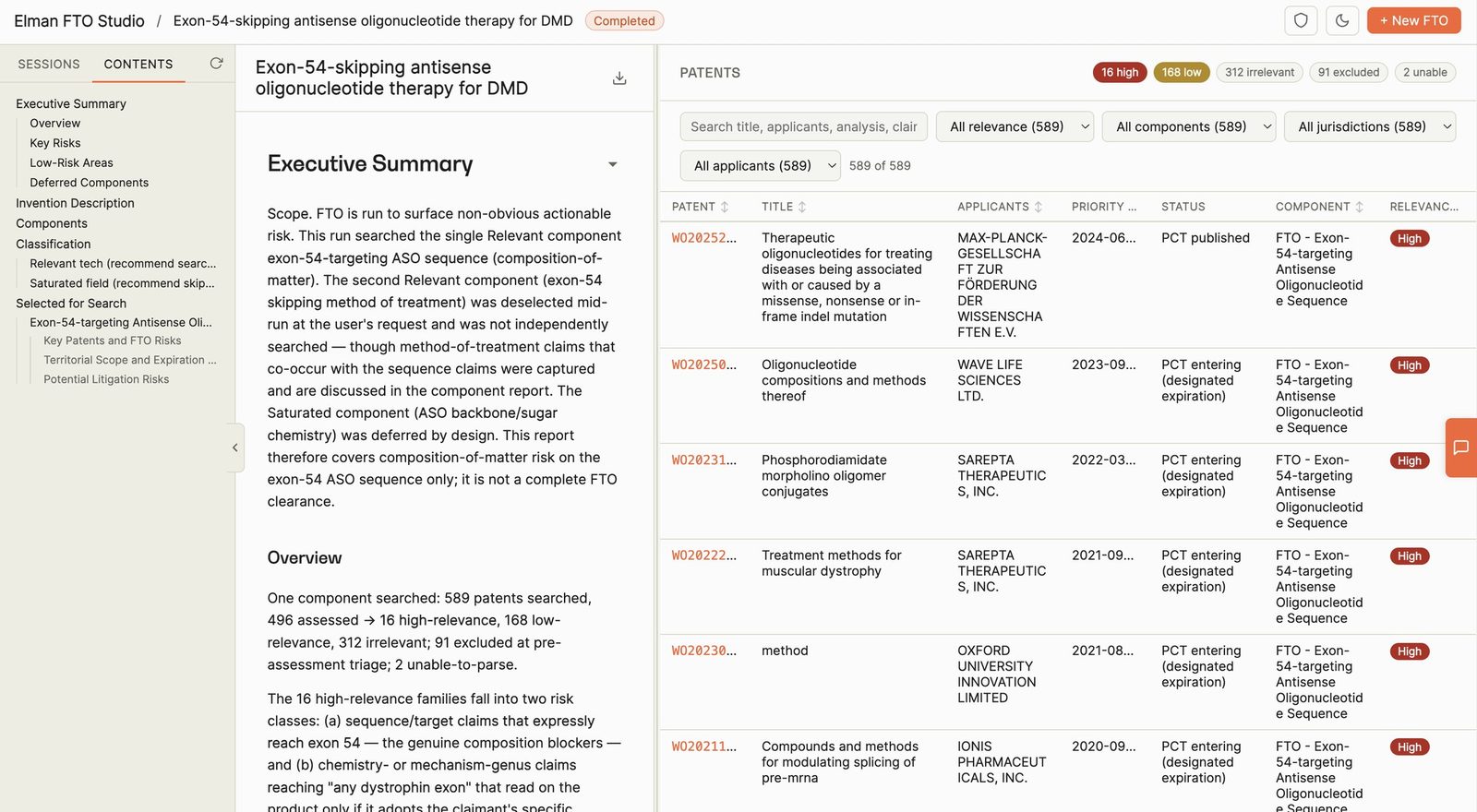
An executive summary naming the patents that actually gate the programme, over a ranked per-patent table. Open any row and you get the claim, the priority date, the jurisdictions where it is granted, and the reasoning for the verdict.
What comes back
A ranked risk table
Every patent assessed, sorted by relevance, filterable by component and jurisdiction. High-relevance hits are the ones you read; the rest is the evidence that they are the only ones you need to.
Claim-level reasoning
Each verdict names the claim, quotes what it covers, and says how your component reads on it. That is what makes it survivable under review — and what makes a design-around discussion concrete.
A written analysis
A summary you can circulate: which patents gate the programme, who owns them, when they expire, and what the routes around them are.
The whole run, kept
Search queries, saturation log, per-patent records and every verdict stay in the session. You can reopen a question months later and see exactly what was searched.
What it is, and what it is not
It is
- A technical FTO analysis with a claim-level evidence trail on every verdict.
- Broad enough to read hundreds of patents per component instead of sampling.
- Reproducible — the search, the stopping point and the reasoning are all recorded.
It is not
- Legal advice, and it does not replace counsel's opinion. It is the work that normally comes before one — done wider, and fast enough to run early.
- A rubber stamp. It surfaces risk and the reasoning behind it; the call is yours.
Request a pilot
We run scoped pilots: you bring one real invention, we run the full analysis on it and walk you through the result. Tell us roughly what you are working on and we will come back with what a pilot would cover.
Prefer email? hello@elman.ai